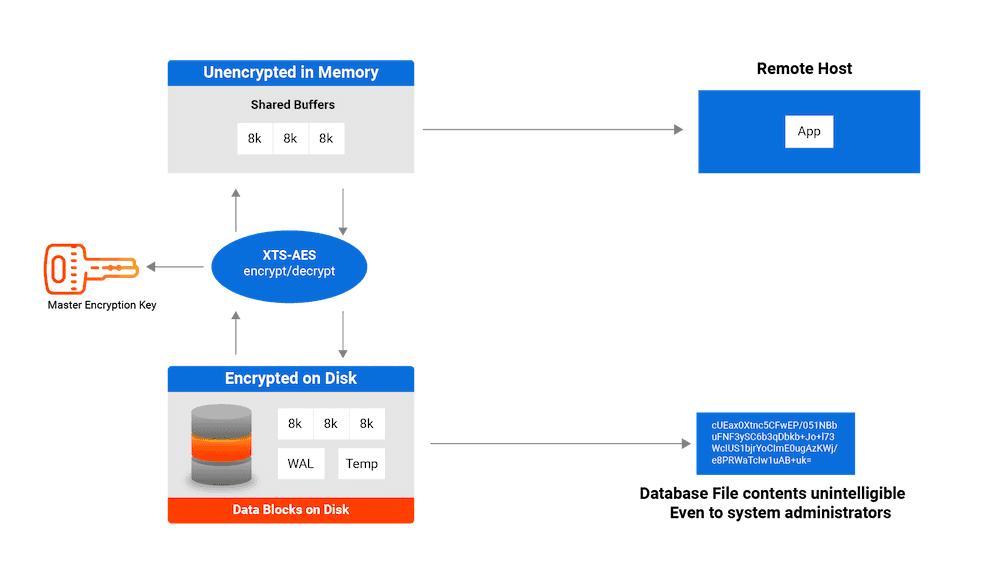
Transparent data encryption (TDE) is an optional feature supported by EDB Postgres Advanced Server and EDB Postgres Extended Server from version 15.
It encrypts any user data stored in the database system. This encryption is transparent to the user. User data includes the actual data stored in tables and other objects as well as system catalog data such as the names of objects.
How does TDE affect performance?
The performance impact of TDE is low. For benchmark details from EDB Postgres Advanced Server 15, see the Transparent Data Encryption Impacts on EDB Postgres Advanced Server 15 blog.
Overview
About TDE
Learn about TDE, how it works, what it encrypts, and why to use it.
TDE compatibility
You can deploy TDE-enabled servers on several supported database distributions and technologies.
Administering
Overview
Understand how to initialize a TDE-encrypted cluster.
Securing the data encryption key
Learn how to secure your data with an encryption key.
Using TDE initialization options
Learn which initdb options to use to enable TDE.
Working with encrypted files
How to work with files in an encrypted environment.
Upgrading
Learn how you can use pg_upgrade to upgrade or migrate TDE databases.
Tutorials
Review some examples of how to create a TDE-enabled database server.
Reference
Commands affected by TDE
How TDE changes the behavior of some commands when enabled.
initdb TDE options
Learn about the initdb options required to initialize a TDE-encrypted database.
Limitations
Learn about TDE limitations.